
A New Approach to Multi-Platform SEO: Maximizing Traffic Acquisition Per Unit of Time (2025)

Jing
October 8, 202520 min read

. The Traditional SEO Playbook
- Use tools like Ahrefs to identify keywords that are highly relevant, low competition, high traffic, and long-tail.
- Analyze the top three search results: examine their traffic sources, article structure, keyword usage, and user search intent.
- Create a content outline by emulating the style and structure of these top-ranking articles.
- Use ChatGPT to generate a 1,500-2,500 word English article based on the outline.
- Manually edit the AI-generated content: enhance semantics, add case studies, include icons/images, implement CTAs, insert internal links, and improve text formatting.
- Submit the article to Google for indexing, then repeat the entire process weekly, producing anywhere from a few to dozens of new blog posts.
While this workflow has become the standard SEO playbook for many, its effectiveness is noticeably declining. Even with strict adherence, it's becoming increasingly difficult to secure meaningful traffic.
I'm not saying this approach is wrong—it remains the best practice for SEO, and you should continue doing it. However, what you need to change is to reallocate a portion of the time you originally spent on SEO to other channels.
2. The Shifting Landscape: Key Changes in Recent Years
Several fundamental shifts are driving this change:
Declining Google Traffic
Users are less reliant on traditional web search. Many now get answers directly from AI chatbots. Younger audiences often search for solutions on YouTube, TikTok, or communities like Reddit or Quora instead of Google. This fragmentation of search behavior across AI and other platforms has reduced Google's overall search volume, thereby diminishing traditional SEO returns.
Evolving Search Engine Results Pages (SERPs)
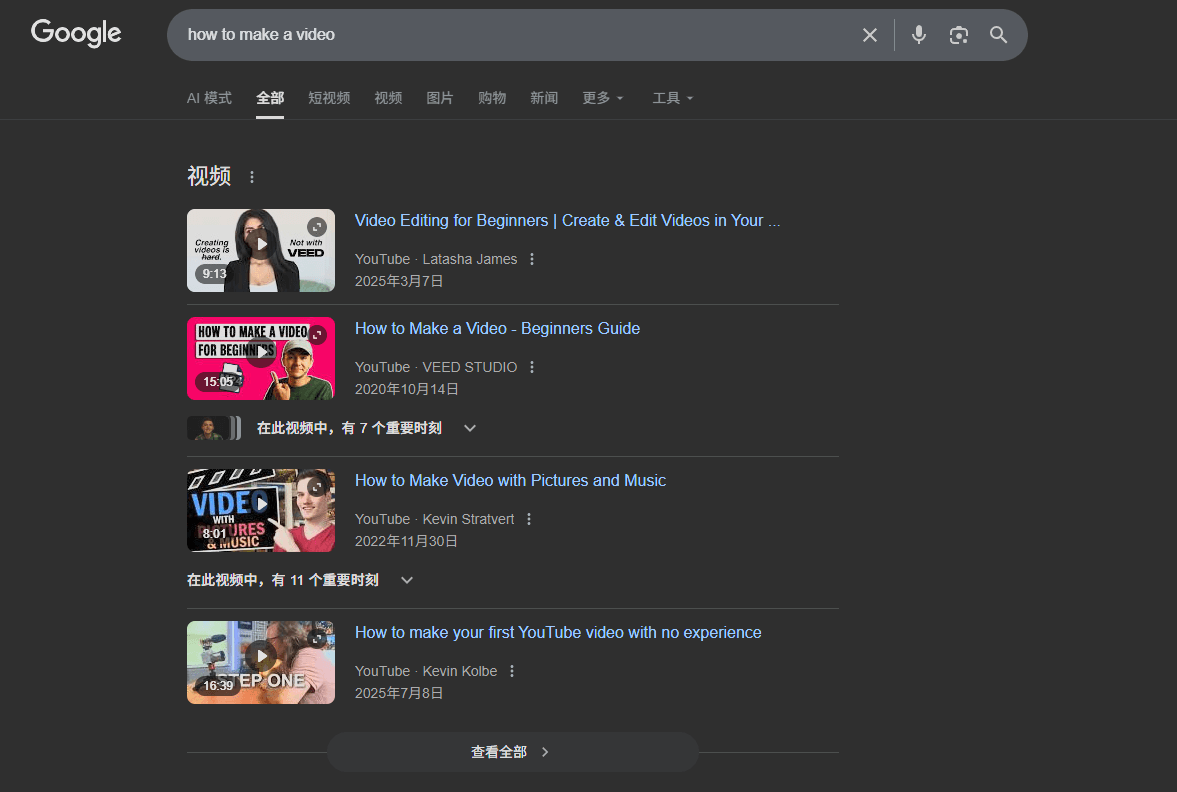
Google's results are no longer dominated by text articles. A significant portion of SERP real estate is now dedicated to YouTube videos and community discussions (e.g., from Reddit). Consequently, the already diminished pool of search traffic is further divided among these different content formats, leaving even less traffic for traditional SEO articles.
3. A New Strategic Direction
Shift Your Core Objective
The ultimate goal is not just to rank for keywords, but to acquire traffic. As Google becomes a harder source, we must reorient our strategy towards "how to acquire more traffic from all platforms." Recognize that traffic sources have diversified; Google's share is now distributed across various platforms and media formats (short/long video, micro-content, images, etc.). Instead of writing 10 articles, repurpose one high-quality piece for 10 different platforms.
Reposition Your Blog
Keyword ranking is no longer the sole priority. Your blog should transition from being a primary traffic channel to serving as your central "knowledge base." It's the repository from which you extract and summarize high-value content for multi-platform distribution. Content shared across the web should link back to this knowledge base, creating a powerful, interconnected web of authority around your core content. This not only brings additional traffic to your SEO articles, but also makes them more likely to be indexed by large language models as authoritative answers.
Focus on Cross-Platform "Amplification"
Move beyond asking "What keywords will boost my article's rank?" Instead, ask "How can my content create 'synergy' across platforms to enhance its overall credibility and authority online?" Multi-platform distribution acts as an amplifier, magnifying truly valuable content. Prioritize creating value-driven content based on genuine experience over chasing volume and rankings. When your content gains widespread "credibility" and "authority," it's more likely to be sourced by AI models, indirectly boosting your visibility.
Prioritize Authentic, Experience-Based Content
Your articles must be grounded in real-world use or testing. Content purely generated by AI lacks unique value. Your audience seeks the genuine insights and experiences that AI cannot replicate. Leverage AI for post-writing tasks: polishing language, adjusting format and tone, or creating illustrations—not for generating core ideas.
Adapt Content for Different Platforms
Each platform has unique format preferences and restrictions.
- SEO Blog (Your Site): Long-form articles (typically 1,500-4,000 words) based on keyword research. Fewer restrictions on owned media. SEO is the most time-consuming part of the work, but it's also the most stable source of traffic. You should treat it as your knowledge base and start creating and maintaining it as early as possible.
- X (Twitter): Primarily text and images. Videos are possible but text often performs better. Strict 280-character limit for non-Premium users (~50 words). X is a social media platform with massive traffic. Its content is more casual, and many influencers use X like a group chat. X is definitely a social media platform worth investing in. Share the experience and value you've accumulated while writing SEO articles on X from time to time.
- Reddit: Text and image-based posts. Strict community rules; values authentic sharing and dislikes overt marketing. Optimal post length is around 300-500 words. Reddit's community culture is very different from X. It abhors self-promotion, so you must disguise yourself as a genuine user sharing your experience, which is quite time-consuming. Reddit is more of a post-centric platform, unlike X which is person-centric (meaning on X, as you accumulate followers, your influence grows). But Reddit doesn't care much about who you are—the virality of each post usually only relates to the post itself. Therefore, Reddit is actually more suitable for early-stage traffic acquisition, but not for long-term investment.
- TikTok/YouTube Shorts/Instagram Reels: Short-form video. Maximum length is typically 3 minutes, but the recommended duration for engagement is 30 seconds to 2 minutes. I believe video platforms are as important as traditional social media, with a trend toward surpassing them. Although video platforms have high traffic, producing videos often comes with high costs (either money or time), so for many people, they often choose between text and video to achieve higher efficiency. However, I believe we can use certain tools to convert SEO articles into short videos.
To efficiently capture traffic, avoid creating unique content for each platform from scratch. Instead, strategically adapt your core written content to fit each platform's requirements.
4. The New 4-Step Workflow for Maximum Traffic
Step 1: Create a Foundational SEO Article
Continue using tools like Ahrefs for keyword research. This is still the first step of all our work. Avoid highly competitive keywords and start with long-tail keywords—I trust these principles don't need reiterating.
Example: For a high-volume keyword like "best tea for sleep," write a detailed, 1,500-2,000 word analysis or review. If you struggle to write a substantive piece, it may indicate a need for deeper product knowledge or a better product-market fit.
Step 2: Build Your X Account
First, you need to find the community where your customer base resides. Use AI tools like ChatGPT to break down your SEO article into dozens of tweets. These tweets must be valuable and genuinely solve people's problems (this is why SEO is the foundation of everything—if you have excellent SEO articles, you'll have great tweets). Make them believe you're someone who can solve their problems. Post 1-3 tweets per day. Since all our content is AI-generated, I believe this won't require any additional time.
Step 3: Convert Short-Form Content into Video
You can use tools like Circlestudio to convert your SEO articles into knowledge-sharing short videos ready for publication, letting it automatically create and distribute videos 24/7. Through this method, you can capture traffic from short video platforms with virtually no additional time investment. I must emphasize once again the importance of the original SEO article—even with tools like Circlestudio, the video content it generates is based on your SEO article. If your article is excellent, the generated short videos will naturally be effective.
Step 4: Adapt Short-Form Content for Reddit
This Reddit step is actually optional, because our principle is "maximize traffic acquisition without spending extra time," and Reddit doesn't quite align with this. Reddit is very unfriendly to new accounts; if your karma score is too low, your account can easily get shadowbanned. Due to Reddit's community atmosphere, you need to disguise yourself as a third party using your product, or even use another account to engage with your main account in a coordinated manner to fake product reviews. These behaviors are too time-consuming and the results are unstable. Therefore, I suggest Reddit can be done selectively.
5. Frequently Asked Questions (FAQ)
How much content should we create per week?
Focus on quality, not quantity. Personally, I produce about 4-8 high-quality articles per month, which is already quite a lot, considering the extensive research required before writing SEO articles. More importantly, you need to update previous articles, interlinking new and old articles to increase user page dwell time.
Should we specifically optimize for Generative Engine Optimization (GEO)?
GEO is essentially a black box; its algorithms and data sourcing are not transparent. Focusing on unclear rules is inefficient—you might spend months on GEO with minimal results, while a site that ignores it gets featured by AI. Instead of direct GEO optimization, concentrate on building cross-platform "authority" and "authenticity." High-quality, well-distributed content is naturally favored by AI models.
Why not create long-form videos as well?
The principle remains maximizing efficiency. Creating both long-form videos (for YouTube) and short-form videos (for TikTok, etc.) doubles the production effort and complicates unified management and distribution. Sticking primarily to the short-form format (under 3 minutes) allows for consistent, efficient repurposing across the most relevant video platforms.